Blockchain community platform · 2023
Turning a 1,500-user beta into a daily habit
Beincom's beta had users but no habit. The PO chose gamification as the growth lever; I designed what to gamify across the user journey, shipped it in two validated phases, and built in safeguards so a token-backed reward economy couldn't be farmed.
- Research
- Strategy
- UX
- UI
- Success metrics & tracking
- Role
- Sole product designer
- Team
- PO, Head of Product, engineering, marketing
- Timeline
- 6 months · Q4/2023 – Q1/2024
- Platform
- Web & mobile
- Outcome
- 61% of DAU on daily tasks in week one
TL;DR
Summary
Two phases, one goal: give people a reason to come back tomorrow. Daily tasks shipped in October 2023 and reached 61% of daily active users within a week. Achievements followed in December. With both live, retention and engagement in the same user cohort rose sharply, and the wider growth push beat its MAU target three times over.
- Daily-task adoption
- 61%
- Of DAU, first 7 days of Phase 1
- Retention
- +25pp
- 40% → 65%, same cohort, 30 days before vs after
- Engagement
- +32pp
- 16% → 48%, same cohort, 30 days before vs after
- MAU
- +300%
- 6-month initiative with marketing; target +100%
People joined, looked around, and didn't come back
Beincom launched its beta in September 2023 with 1,500 users. There is no friending or following: everything happens inside communities. When a community is quiet, there is nothing to come back to. Only 16% of users engaged with content and 40% were retained.
Competing with Facebook Groups and Discord, a newer product needed a reason for people to open it every day, before it had enough content to be that reason on its own.
+100% MAUBOD target for Q4/2023 – Q1/2024
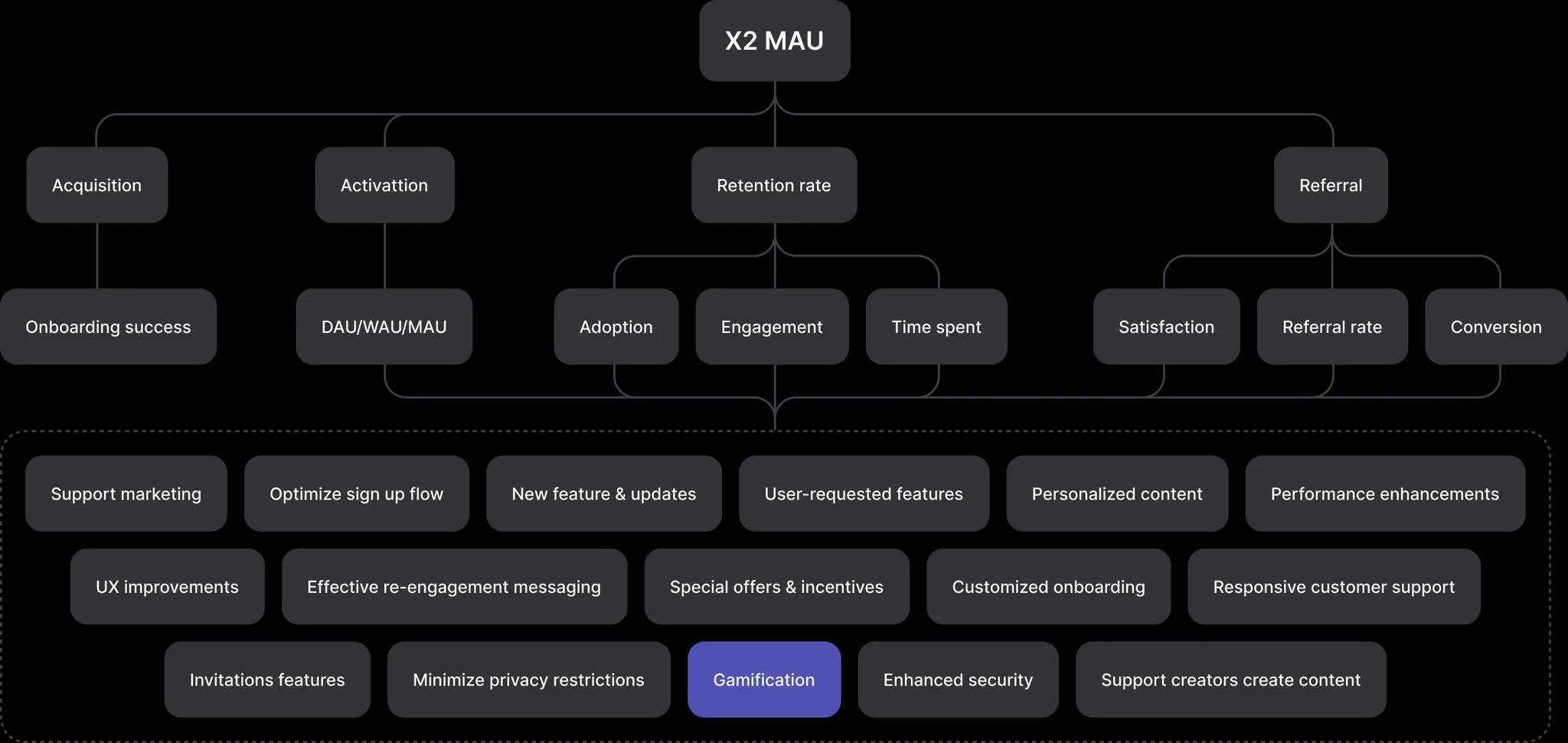
Retention was the branch worth pulling
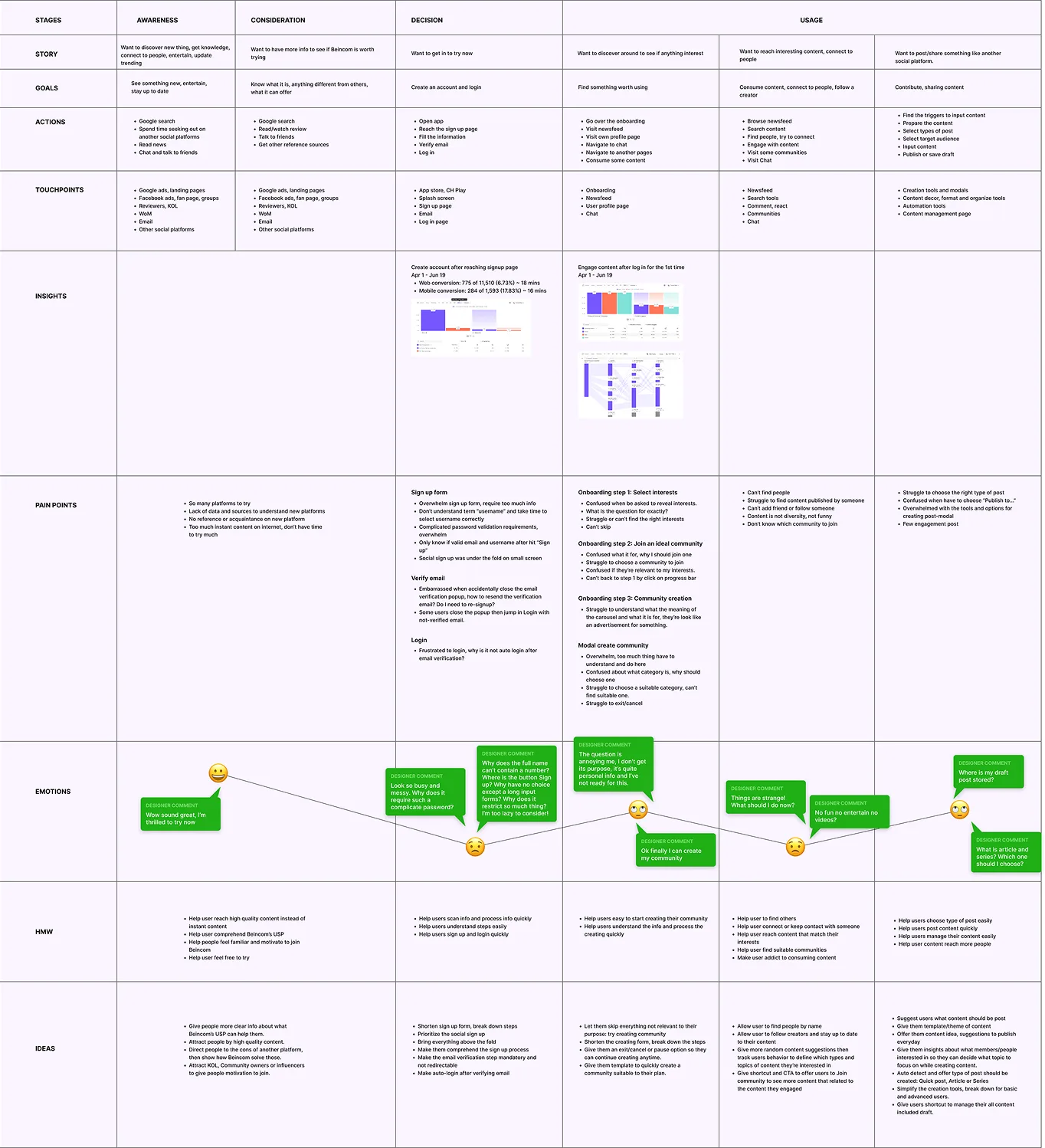
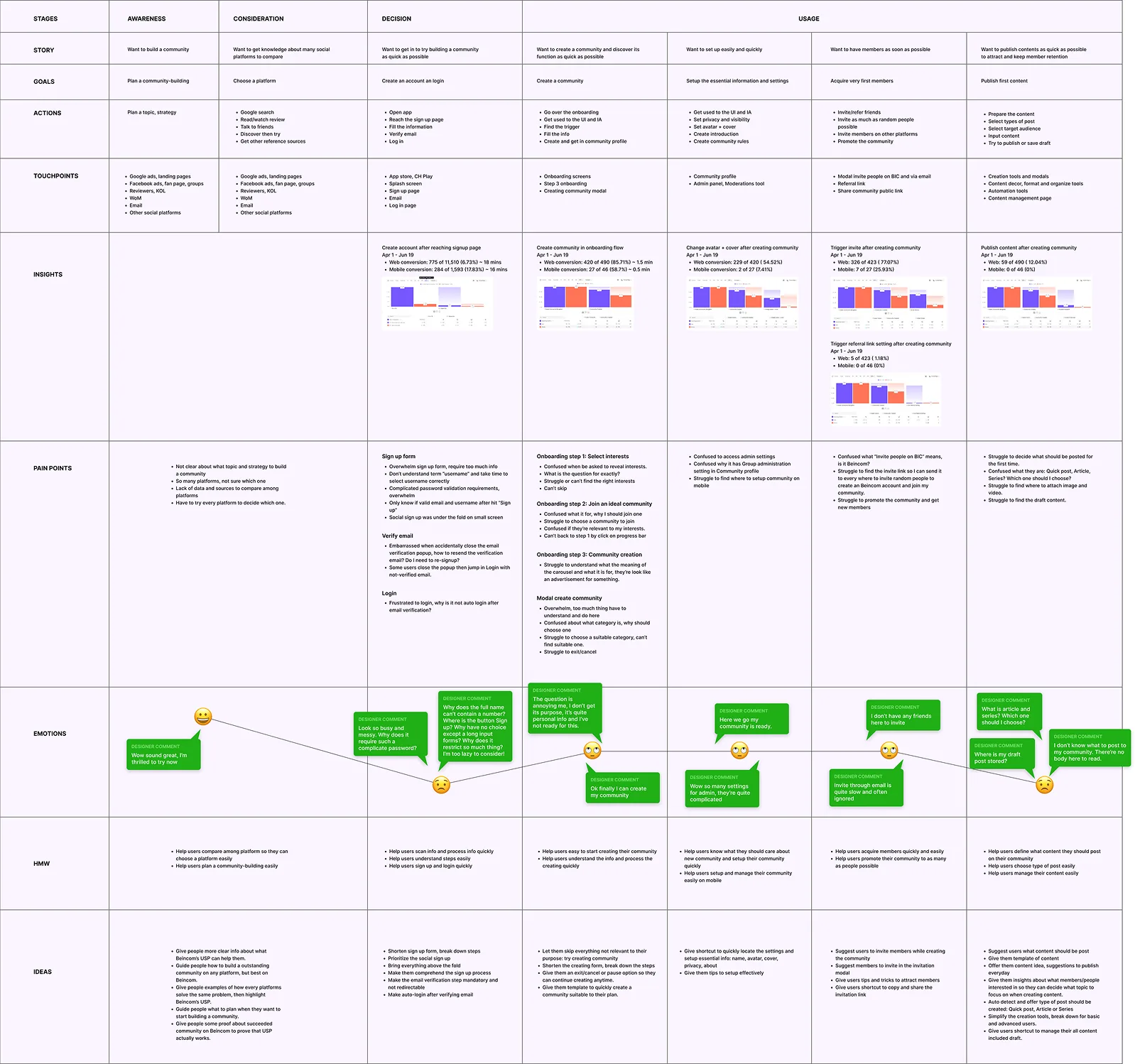
The PO and I broke the MAU target into a metric tree, then interviewed five users across our three groups (community owners, creators and consumers) to find where the journey broke.
01
Quiet communities stay quiet
Owners struggled to attract members into an empty space, and consumers found nothing worth returning to.
02
Acting gave nothing back
Reading was effortless, but posting, reacting or completing a profile earned users nothing.
03
Nothing pulled people back
Once a session ended, nothing gave anyone a reason to come back tomorrow.
Build an in-app economy where users earn medals for meaningful activity.
Five ideas, two shipped
I mapped every moment in the journey that could earn or spend medals. The PO prioritised them against effort and the BOD deadline.
01Shipped · Phase 1
Reward everyday activity
Log in, react, comment, post.
02Shipped · Phase 2
Reward one-time & lifetime milestones
Complete a profile, finish the community checklist, invite people to Beincom or into a community.
03Not pursued
Leaderboards
Top contributors, posts and communities.
04Backlog
Spend medals on people
Tip creators, donate to community admins.
05Backlog
Spend medals on identity
Avatar frames, profile covers, name badges.
Three calls that shaped the system
01
Reward the habit, not the tap
- Insight
- Users had no reason to return daily, and consumers, the largest group, rarely acted at all.
- Decision
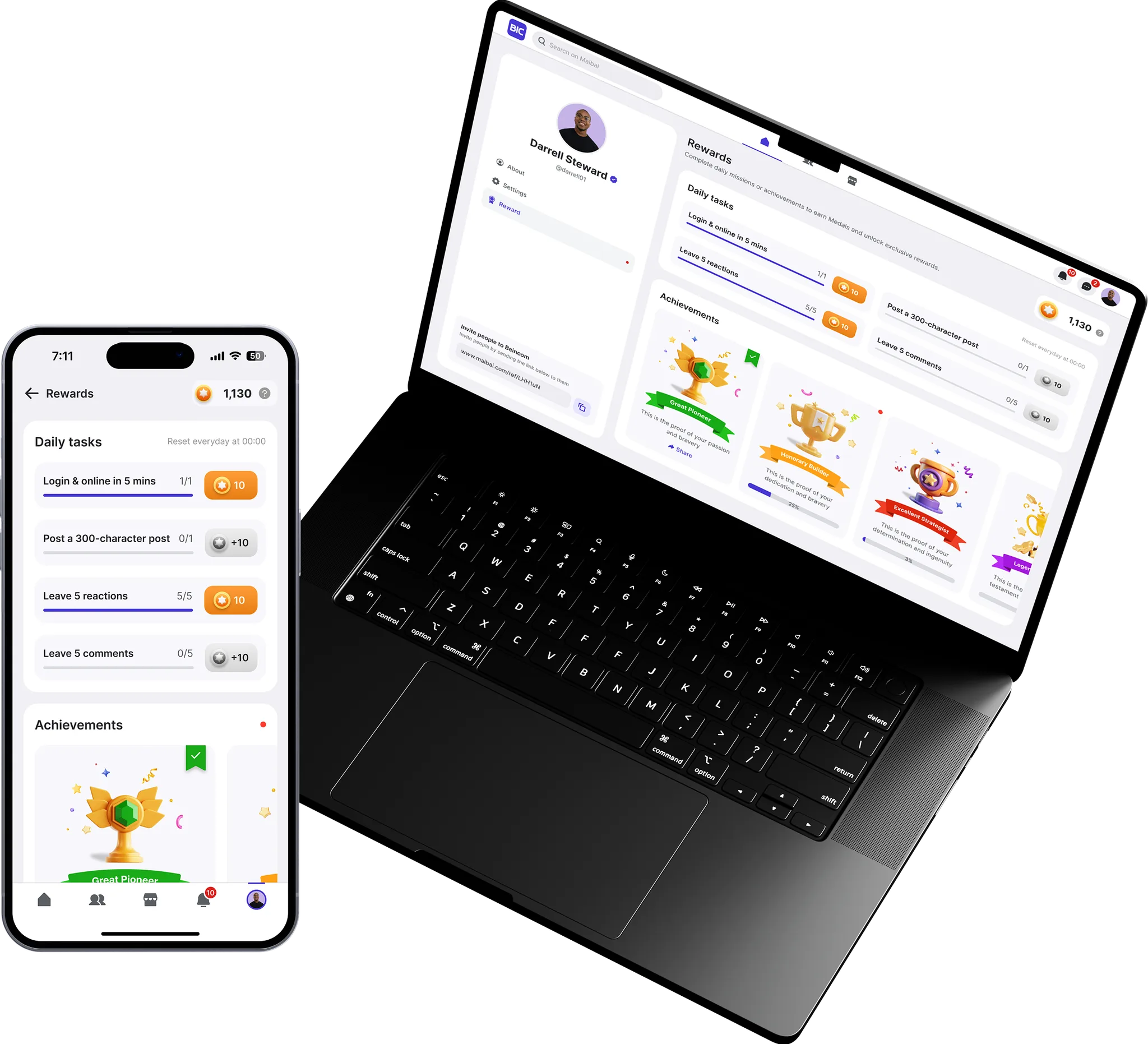
- Four daily tasks, reset at 00:00 server time, each with a minimum bar: stay online for 5 minutes, leave 5 reactions, leave 5 comments, write a 300-character post. Consumers can earn on day one, and the post task nudges them toward creating.
- Trade-off
- Every threshold is a guess at the line between real activity and farming. Set it too high and casual users give up; too low and medals stop meaning anything. We kept each one finishable in a single session and left tuning to the data.
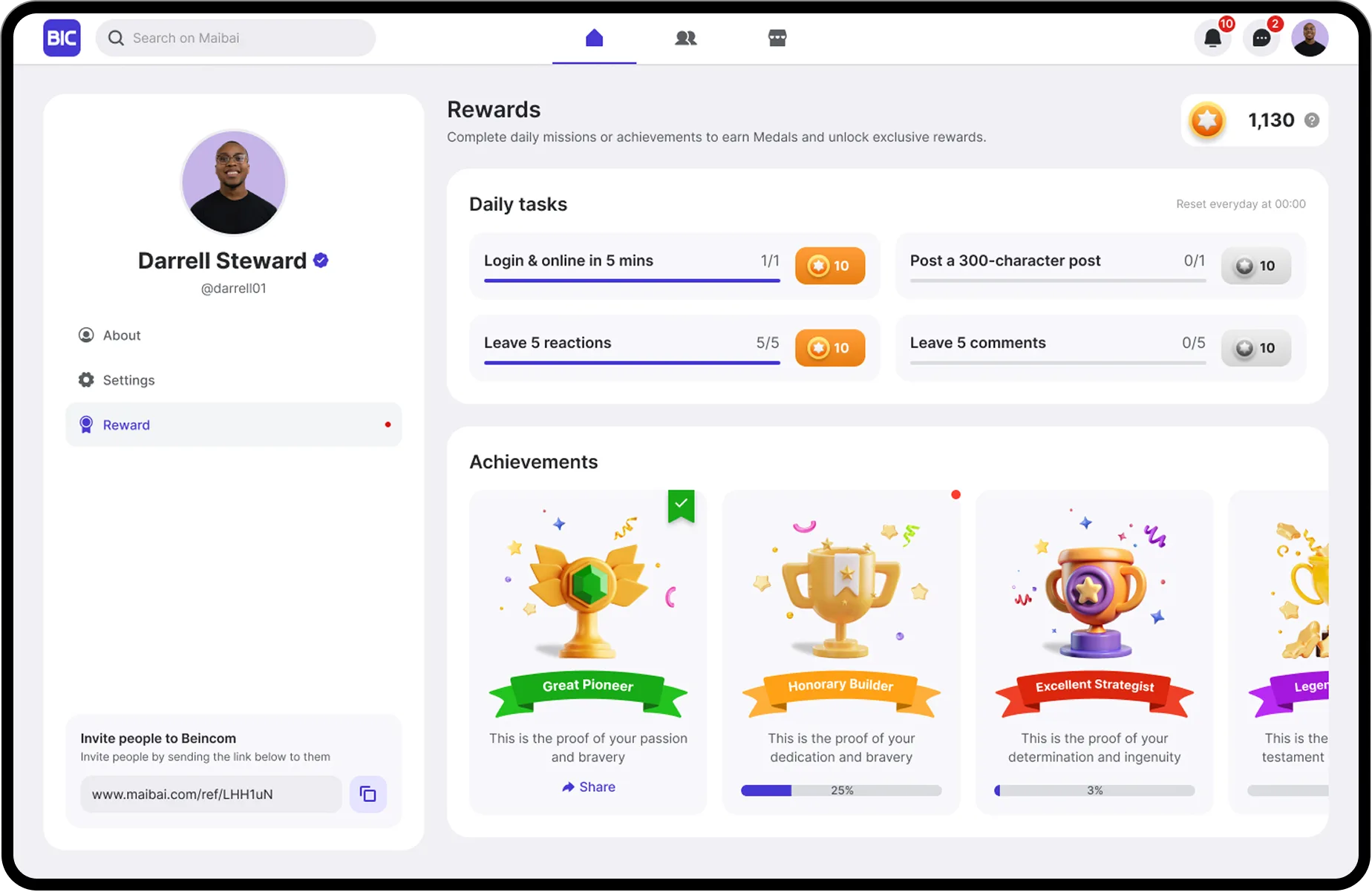
(Daily tasks) 02
Prove the habit before building the ladder
- Insight
- Achievements only matter if people already come back.
- Decision
- Phase 1 (early October 2023) shipped daily tasks alone, with adoption and engagement in Mixpanel as the gate. 61% of DAU completed tasks in the first week, and the share kept climbing. Phase 2 (late December 2023) then added Achievements: one-time and lifetime goals, including referrals and invites, worth 10× a daily task.
- Trade-off
- It took longer to reach the full system, but we didn't build a progression layer on top of an unproven loop.
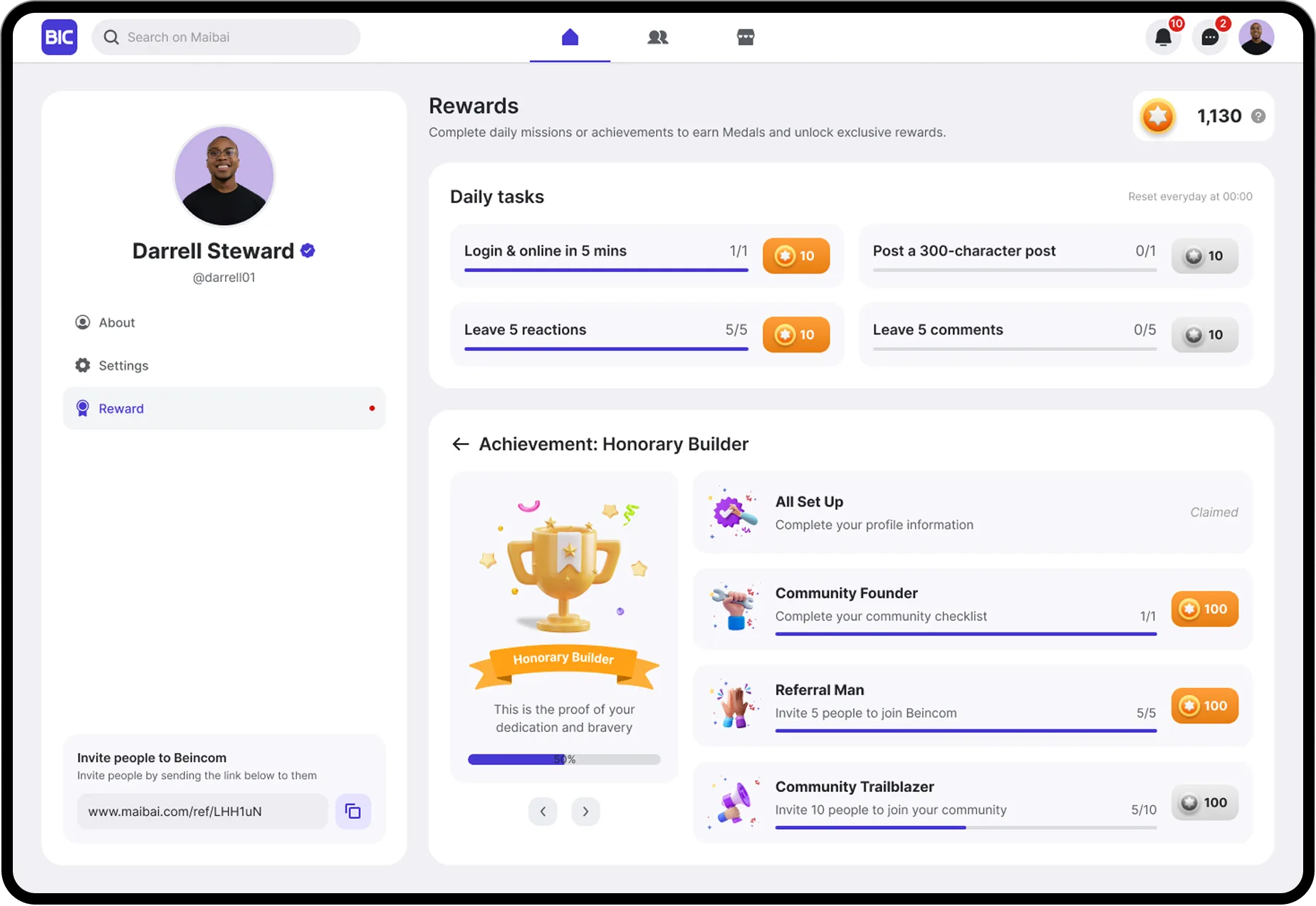
(Achievements) 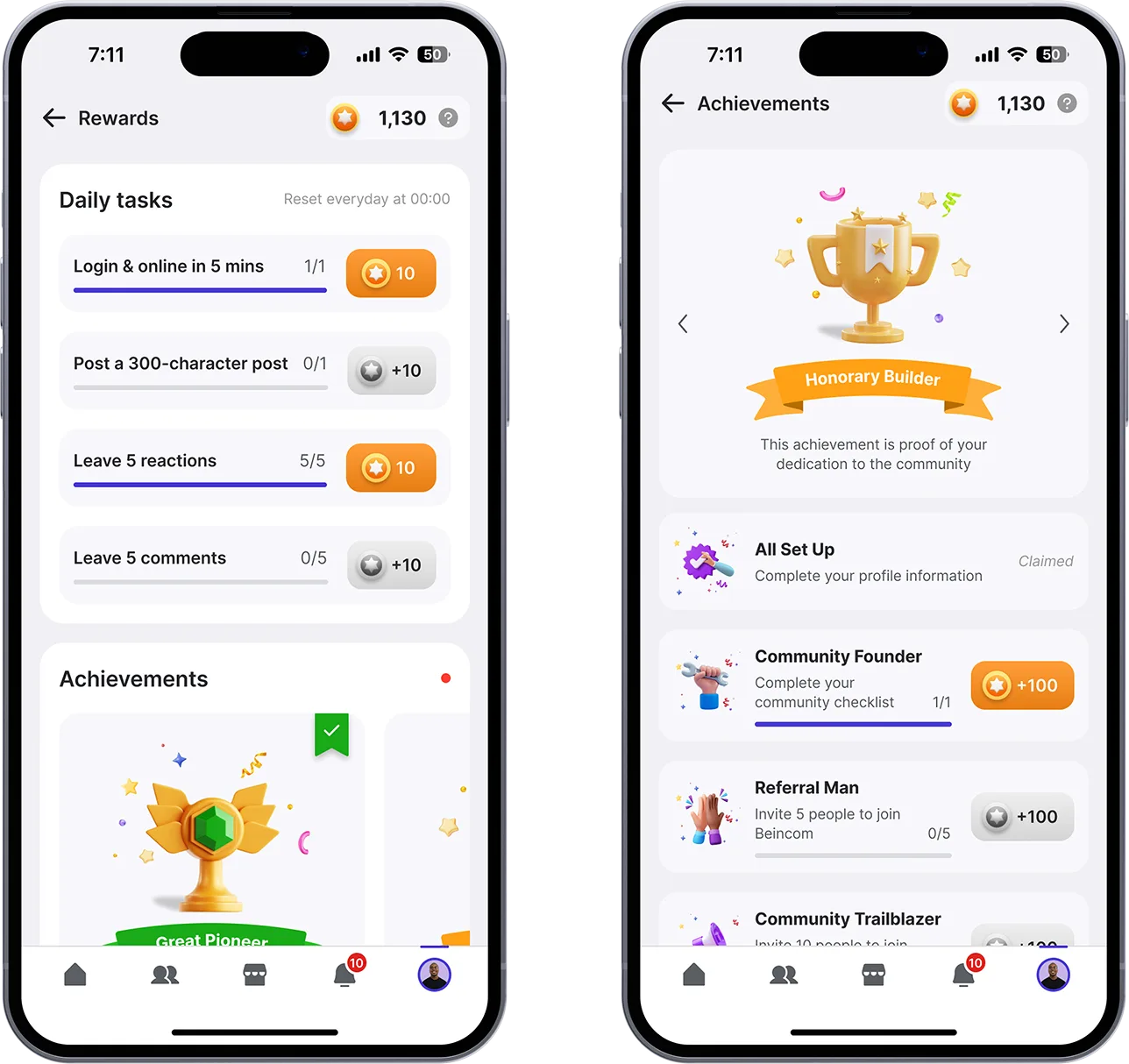
(Rewards on mobile) 03
Assume it will be farmed
- Insight
- Medals were planned to convert into unlockable tokens once Beincom's coin listed, which gave throwaway accounts a real-money incentive.
- Decision
- I proposed eKYC to block throwaway accounts, and a limit of one claim per task, per account, per server day. Both shipped.
- Trade-off
- eKYC adds friction, and some farming risk remains. The PO and Head of Product accepted that in exchange for the retention and MAU goals, and deferred the conversion rate to a three-month review of how medals were distributed across accounts.
The phase I didn't get to ship
Phases 1 and 2 let people earn medals, but gave them nowhere to spend them inside the app.
I proposed a Phase 3 that would make medals a currency. Users could tip creators whose community posts they valued, and buy avatar frames, profile covers and name badges that show up wherever they chat, comment or react, a pattern Discord has proven. Tipping would turn consumers into creators, and creators drive everyone else's engagement.
The PO said no. There was no evidence it would pay off, it was expensive to build, and the BOD deadline was fixed. For that timeline, that was the right call. The idea went into the backlog.
Next time I'd pitch a cheap test instead of a full system: tipping only, inside one community, with a clear success metric.
Measured, not guessed
We defined success metrics and tracking events with the PO before Phase 1 shipped, so every release was read through Mixpanel funnels, retention reports and session recordings.
Phase 1 was read over its first 30 days to decide whether to build Phase 2. With both phases live, we compared the 30 days after Phase 2 with the 30 days before Phase 1 in the same cohort: retention rose from 40% to 65% and engagement from 16% to 48%. Across the six-month initiative, MAU grew 300% against a +100% target.
Thirty days shows that people engaged; it doesn't prove long-term retention. The MAU gain also reflects marketing running in parallel.
What I'd carry forward
01
Start from the metric tree, not the feature
Gamification earned its place because it moved several branches of the goal tree at once.
02
Instrument before launch
Defining tracking events up front made the phase gate a data decision, not a debate.
03
Hold out a control group
A before/after comparison can't separate rewards from novelty or marketing. A small holdout would have.
Next case
- Onboarding that asks less and gives back more
- —